Why MEDDIC Implementations Fail—and What to Fix in Your CRM
MEDDIC usually arrives with the right intentions. Leadership wants more rigorous qualification, fewer surprises at the end of the quarter, and a forecast grounded in evidence rather than optimism.
The rollout often looks sensible too. The team receives training. New fields appear in the CRM. Managers add MEDDIC to pipeline reviews. For a few weeks, everyone pays attention.
Then adoption fades.
Reps enter short answers just before a review. Managers disagree about what “complete” means. The score looks healthy while the deal is clearly at risk. Eventually, MEDDIC becomes another administrative layer—present in the CRM, but absent from the way the team actually sells.
This is often described as a training or discipline problem. More often, it is a system-design problem.
MEDDIC is a way to investigate and evaluate a deal. A CRM is the operating environment in which that investigation has to become visible, useful, and repeatable. If the two are poorly connected, even a well-trained team will struggle to sustain the methodology.
MEDDIC is not a form
MEDDIC helps a seller develop a clear view of an opportunity:
- Metrics: What measurable outcome makes the change worthwhile?
- Economic Buyer: Who can authorize the investment, and what matters to them?
- Decision Criteria: How will the customer compare the available options?
- Decision Process: What steps and approvals stand between interest and a decision?
- Identify Pain: What important problem is the customer trying to solve?
- Champion: Who has influence, credibility, and a personal interest in helping the deal move?
- Competition: What alternatives—including doing nothing—could win instead?
These are not seven facts collected once. They are hypotheses that become stronger, weaker, or obsolete as a deal progresses.
That distinction matters. When the CRM presents MEDDIC as seven empty text boxes, it encourages completion rather than investigation. The seller’s goal quietly shifts from understanding the deal to filling the fields.
A completed field is not the same as verified evidence. A contact with a senior title is not necessarily the Economic Buyer. A friendly stakeholder is not necessarily a Champion. A benefit is not a Metric. And a target close date is not a Decision Process.
The CRM must help the team preserve those distinctions.
The most common failure patterns
1. The CRM is configured before the sales process is defined
Teams often begin by asking, “Which MEDDIC fields should we add?” That is too late in the design process.
First, the business needs to decide how opportunities should progress. What evidence should exist at each stage? Which risks should stop a deal from advancing? Who validates the qualification? What does a manager expect to see before committing a deal to the forecast?
Without those decisions, CRM configuration becomes a collection of fields with no operating logic behind them.
2. Every field is treated as equally important at every stage
An early discovery call should not require the same depth of qualification as a late-stage proposal. If the CRM demands everything too soon, sellers enter weak assumptions to get past the gate. If it demands nothing until the end, the team discovers critical gaps when there is little time left to resolve them.
Good implementation is progressive. Pain and an initial view of value may matter early. The Decision Process, Economic Buyer access, and a tested Champion should become more rigorous as the opportunity advances.
3. MEDDIC data is separated from the rest of the deal
Qualification does not live in isolation. It is connected to contacts, meetings, notes, next steps, products, deal stages, close dates, and customer activity.
If a seller records the Economic Buyer as free text while the CRM has no associated contact or role, the information cannot support stakeholder mapping. If the Decision Process is stored as a paragraph with no dates or owners, it cannot guide execution. If the stated pain never appears in the value proposition, the team has captured data without changing the deal strategy.
4. The system measures completeness instead of quality
Completeness is useful, but it is only a starting point. A deal can have every MEDDIC field populated and still be poorly qualified.
The CRM should make uncertainty visible. Teams can distinguish between an assumption, customer-confirmed information, and evidence validated through action. They can also record when an answer was last reviewed. A five-month-old Decision Process should not carry the same confidence as one confirmed in yesterday’s meeting.
5. Data entry produces no immediate value for the seller
If entering MEDDIC information only helps management build a report, adoption will always require pressure. The system should return value to the rep: a clearer next action, a visible risk, a stronger deal review, or less time spent reconstructing context before a meeting.
The closer MEDDIC sits to the seller’s normal workflow, the more likely it is to become a habit. That means surfacing qualification on the deal record, using existing CRM activity where appropriate, and avoiding duplicate entry across documents, spreadsheets, and tools.
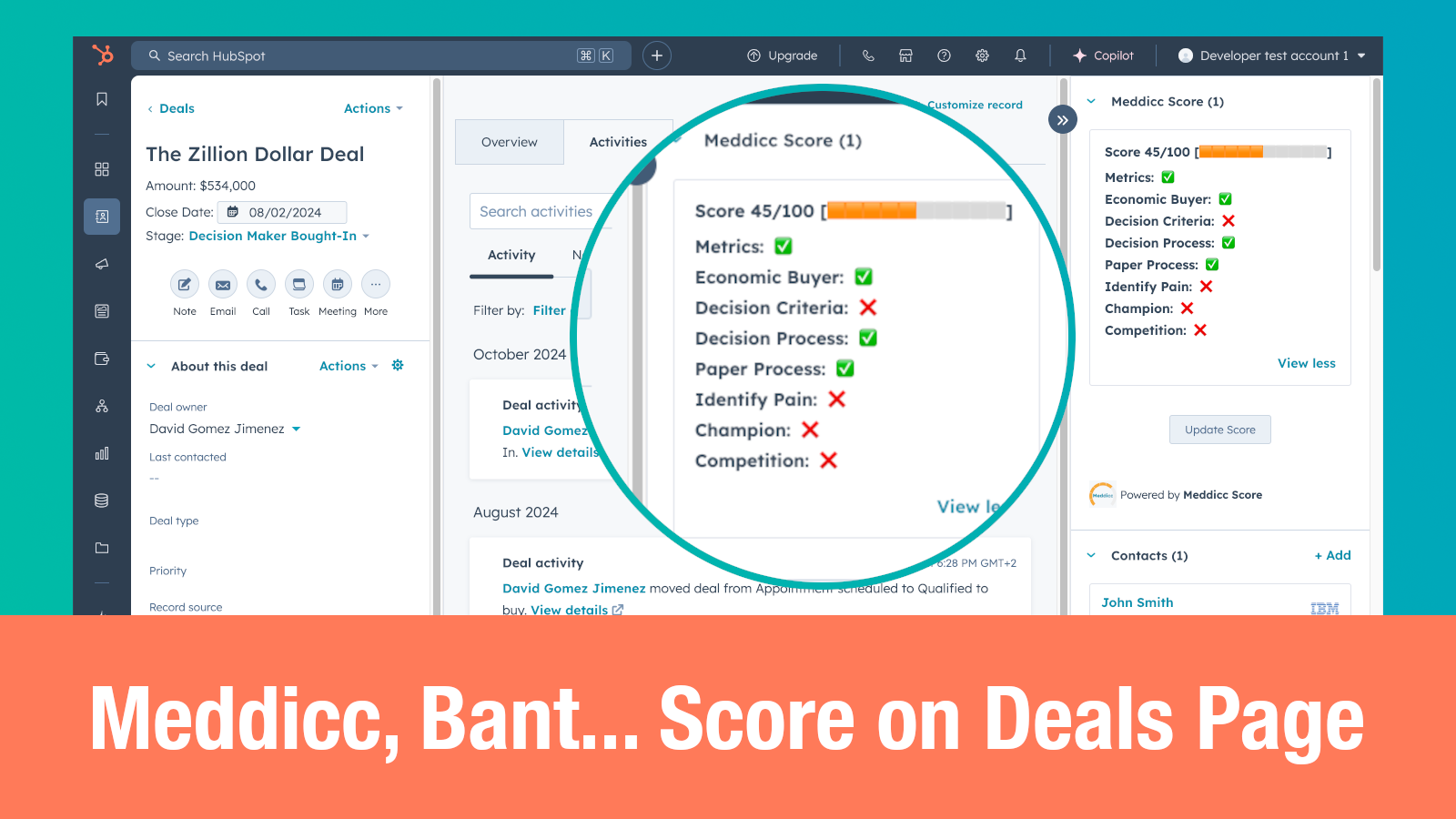
This is one of the practical advantages of using Meddicc Score inside HubSpot: qualification stays attached to the deal record, where sellers already work, rather than becoming a separate document they have to remember to maintain.
6. Managers inspect fields but do not coach the evidence
MEDDIC cannot be implemented by software alone. Its value appears in the questions it creates.
“Economic Buyer: complete” is not a coaching conversation. “What evidence shows this person controls the budget, and when will we speak with them?” is.
Managers need a consistent way to challenge weak assumptions and convert gaps into actions. Otherwise the team learns that the score matters more than the truth behind it.
What to change in the CRM
Fixing the implementation does not necessarily mean adding more fields. It means designing the CRM around how the team qualifies, advances, and reviews opportunities.
Start with stage-specific evidence
For each sales stage, define the minimum evidence that justifies progression. Keep the list short enough to be usable and strict enough to be meaningful.
For example:
- At an early stage, require a clearly described pain, the people involved, and a plausible reason to act.
- Before solution validation, expect measurable outcomes and documented Decision Criteria.
- Before proposal or commitment, expect a mapped Decision Process, credible Champion, and a plan for reaching the Economic Buyer.
The exact rules will vary by sales motion. That is the point: the CRM should reflect how your customers buy, not a generic template.
Use the right data structure
Some MEDDIC information belongs in concise narrative fields. Other information should be structured.
Stakeholders should be connected to contact records and roles. Key decision steps should have dates and owners. Metrics should include a baseline, target, and business impact where possible. Competition should include the status quo, not only named vendors.
Structured data improves reporting and automation. Narrative preserves nuance. A useful implementation needs both.
Separate missing information from negative evidence
“We do not know who the Economic Buyer is” and “the Economic Buyer has declined to engage” are different risks. A blank field cannot express that difference.
Build statuses that show whether an element is unknown, assumed, confirmed, or at risk. This gives managers a more honest pipeline view and helps sellers decide what to do next.
Make automation serve the process
Automation should reduce friction and expose risk, not manufacture confidence.
Useful automations might flag a late-stage deal with no Economic Buyer identified, prompt a review when the Decision Process is stale, or create a task when a key qualification gap remains unresolved. Automation can also bring relevant deal activity into the qualification workflow so sellers do not have to repeat information the CRM already contains.
But automatic field population still needs human review. MEDDIC depends on judgment, context, and customer confirmation. AI can help summarize evidence; it should not turn a plausible inference into an unquestioned fact.
Used with that discipline, Meddicc Score can help teams review CRM activity, refill qualification answers as new information appears, and make incomplete areas easier to spot. The seller and manager still decide whether the evidence is credible; the app reduces the effort required to find and organize it.
Design dashboards for decisions
A MEDDIC dashboard should do more than rank deals by a single score. It should help leaders see patterns:
- Which committed deals have no verified Economic Buyer?
- Where are Decision Processes incomplete or outdated?
- Which stages accumulate the most qualification gaps?
- Are deals moving forward while evidence quality stays flat?
- Which risks recur across the team and require coaching?
The aim is not to create another management screen. It is to improve resource allocation, deal coaching, and forecast judgment.
Roll out the operating system, not just the fields
A sustainable rollout can begin with one team or one segment. Configure the smallest useful version, test it in real deal reviews, and watch where the workflow creates confusion or unnecessary effort.
Then refine it with the people who use it. Reps will reveal where data is duplicated. Managers will reveal which evidence is too vague to coach. Revenue Operations will see where definitions break reporting. Leadership will see whether the new information changes forecast decisions.
Training should use live opportunities, not only fictional examples. The team needs to practice the difference between a label and evidence: contact versus Champion, executive versus Economic Buyer, desired benefit versus quantified Metric.
Finally, measure adoption through behavior and outcomes—not simply field completion. Are reviews more focused? Are risks found earlier? Are next steps clearer? Does the forecast have fewer late surprises? Those signals tell you whether MEDDIC is becoming part of the operating system.
When CRM configuration becomes revenue design
For a small team with a clear sales motion, this redesign may be manageable internally. In a larger or more complex organization, the difficult part is rarely clicking the right settings. It is aligning sales stages, qualification standards, roles, automation, reporting, and management behavior before the build begins.
That is where an external revenue-operations perspective can be valuable. Sention is a natural example: its approach starts by mapping how the business actually operates before configuring technology, then connects sales, marketing, and operations as one revenue system. That sequence matters because another layer of CRM configuration will not repair a process the organization has never clearly designed.
The principle applies whether the work is done internally or with specialist support: diagnose first, design second, configure third.
The CRM should make good selling easier
MEDDIC does not fail because it is too rigorous. It fails when rigor is translated into administration without context, coaching, or a clear benefit for the seller.
The best CRM implementation makes the methodology feel less like reporting and more like deal navigation. It shows what the team knows, what it is assuming, what has changed, and what must happen next. It gives managers better questions and gives sellers a clearer path through complex opportunities.
Tools such as Meddicc Score can reduce the burden by keeping qualification visible in the CRM, organizing the evidence, and helping teams identify gaps. But the tool works best on top of a deliberately designed sales process.
Before asking why your team is not completing MEDDIC, ask a more useful question:
Has the CRM been designed to help them use it?