<?xml version="1.0" encoding="utf-8"?><feed xmlns="http://www.w3.org/2005/Atom" ><generator uri="https://jekyllrb.com/" version="3.10.0">Jekyll</generator><link href="https://meddiccscore.com/feed.xml" rel="self" type="application/atom+xml" /><link href="https://meddiccscore.com/" rel="alternate" type="text/html" /><updated>2026-08-24T17:54:20+00:00</updated><id>https://meddiccscore.com/feed.xml</id><title type="html">Meddicc Score</title><subtitle>Simplify your sales process with automated MEDDICC score for HubSpot integration. Transform tedious tasks into actionable insights and enhance your team’s efficiency with ease.</subtitle><author><name>Meddicc Score</name></author><entry><title type="html">Why MEDDIC Implementations Fail—and What to Fix in Your CRM</title><link href="https://meddiccscore.com/blog/why-meddic-implementations-fail-crm/" rel="alternate" type="text/html" title="Why MEDDIC Implementations Fail—and What to Fix in Your CRM" /><published>2026-08-13T07:00:00+00:00</published><updated>2026-08-13T07:00:00+00:00</updated><id>https://meddiccscore.com/blog/why-meddic-implementations-fail-crm</id><content type="html" xml:base="https://meddiccscore.com/blog/why-meddic-implementations-fail-crm/"><![CDATA[<h1 id="why-meddic-implementations-failand-what-to-fix-in-your-crm">Why MEDDIC Implementations Fail—and What to Fix in Your CRM</h1>

<p>MEDDIC usually arrives with the right intentions. Leadership wants more rigorous qualification, fewer surprises at the end of the quarter, and a forecast grounded in evidence rather than optimism.</p>

<p>The rollout often looks sensible too. The team receives training. New fields appear in the CRM. Managers add MEDDIC to pipeline reviews. For a few weeks, everyone pays attention.</p>

<p>Then adoption fades.</p>

<p>Reps enter short answers just before a review. Managers disagree about what “complete” means. The score looks healthy while the deal is clearly at risk. Eventually, MEDDIC becomes another administrative layer—present in the CRM, but absent from the way the team actually sells.</p>

<p>This is often described as a training or discipline problem. More often, it is a system-design problem.</p>

<p>MEDDIC is a way to investigate and evaluate a deal. A CRM is the operating environment in which that investigation has to become visible, useful, and repeatable. If the two are poorly connected, even a well-trained team will struggle to sustain the methodology.</p>

<h2 id="meddic-is-not-a-form">MEDDIC is not a form</h2>

<p>MEDDIC helps a seller develop a clear view of an opportunity:</p>

<ul>
  <li><strong>Metrics:</strong> What measurable outcome makes the change worthwhile?</li>
  <li><strong>Economic Buyer:</strong> Who can authorize the investment, and what matters to them?</li>
  <li><strong>Decision Criteria:</strong> How will the customer compare the available options?</li>
  <li><strong>Decision Process:</strong> What steps and approvals stand between interest and a decision?</li>
  <li><strong>Identify Pain:</strong> What important problem is the customer trying to solve?</li>
  <li><strong>Champion:</strong> Who has influence, credibility, and a personal interest in helping the deal move?</li>
  <li><strong>Competition:</strong> What alternatives—including doing nothing—could win instead?</li>
</ul>

<p>These are not seven facts collected once. They are hypotheses that become stronger, weaker, or obsolete as a deal progresses.</p>

<p>That distinction matters. When the CRM presents MEDDIC as seven empty text boxes, it encourages completion rather than investigation. The seller’s goal quietly shifts from understanding the deal to filling the fields.</p>

<p>A completed field is not the same as verified evidence. A contact with a senior title is not necessarily the Economic Buyer. A friendly stakeholder is not necessarily a Champion. A benefit is not a Metric. And a target close date is not a Decision Process.</p>

<p>The CRM must help the team preserve those distinctions.</p>

<h2 id="the-most-common-failure-patterns">The most common failure patterns</h2>

<h3 id="1-the-crm-is-configured-before-the-sales-process-is-defined">1. The CRM is configured before the sales process is defined</h3>

<p>Teams often begin by asking, “Which MEDDIC fields should we add?” That is too late in the design process.</p>

<p>First, the business needs to decide how opportunities should progress. What evidence should exist at each stage? Which risks should stop a deal from advancing? Who validates the qualification? What does a manager expect to see before committing a deal to the forecast?</p>

<p>Without those decisions, CRM configuration becomes a collection of fields with no operating logic behind them.</p>

<h3 id="2-every-field-is-treated-as-equally-important-at-every-stage">2. Every field is treated as equally important at every stage</h3>

<p>An early discovery call should not require the same depth of qualification as a late-stage proposal. If the CRM demands everything too soon, sellers enter weak assumptions to get past the gate. If it demands nothing until the end, the team discovers critical gaps when there is little time left to resolve them.</p>

<p>Good implementation is progressive. Pain and an initial view of value may matter early. The Decision Process, Economic Buyer access, and a tested Champion should become more rigorous as the opportunity advances.</p>

<h3 id="3-meddic-data-is-separated-from-the-rest-of-the-deal">3. MEDDIC data is separated from the rest of the deal</h3>

<p>Qualification does not live in isolation. It is connected to contacts, meetings, notes, next steps, products, deal stages, close dates, and customer activity.</p>

<p>If a seller records the Economic Buyer as free text while the CRM has no associated contact or role, the information cannot support stakeholder mapping. If the Decision Process is stored as a paragraph with no dates or owners, it cannot guide execution. If the stated pain never appears in the value proposition, the team has captured data without changing the deal strategy.</p>

<h3 id="4-the-system-measures-completeness-instead-of-quality">4. The system measures completeness instead of quality</h3>

<p>Completeness is useful, but it is only a starting point. A deal can have every MEDDIC field populated and still be poorly qualified.</p>

<p>The CRM should make uncertainty visible. Teams can distinguish between an assumption, customer-confirmed information, and evidence validated through action. They can also record when an answer was last reviewed. A five-month-old Decision Process should not carry the same confidence as one confirmed in yesterday’s meeting.</p>

<h3 id="5-data-entry-produces-no-immediate-value-for-the-seller">5. Data entry produces no immediate value for the seller</h3>

<p>If entering MEDDIC information only helps management build a report, adoption will always require pressure. The system should return value to the rep: a clearer next action, a visible risk, a stronger deal review, or less time spent reconstructing context before a meeting.</p>

<p>The closer MEDDIC sits to the seller’s normal workflow, the more likely it is to become a habit. That means surfacing qualification on the deal record, using existing CRM activity where appropriate, and avoiding duplicate entry across documents, spreadsheets, and tools.</p>

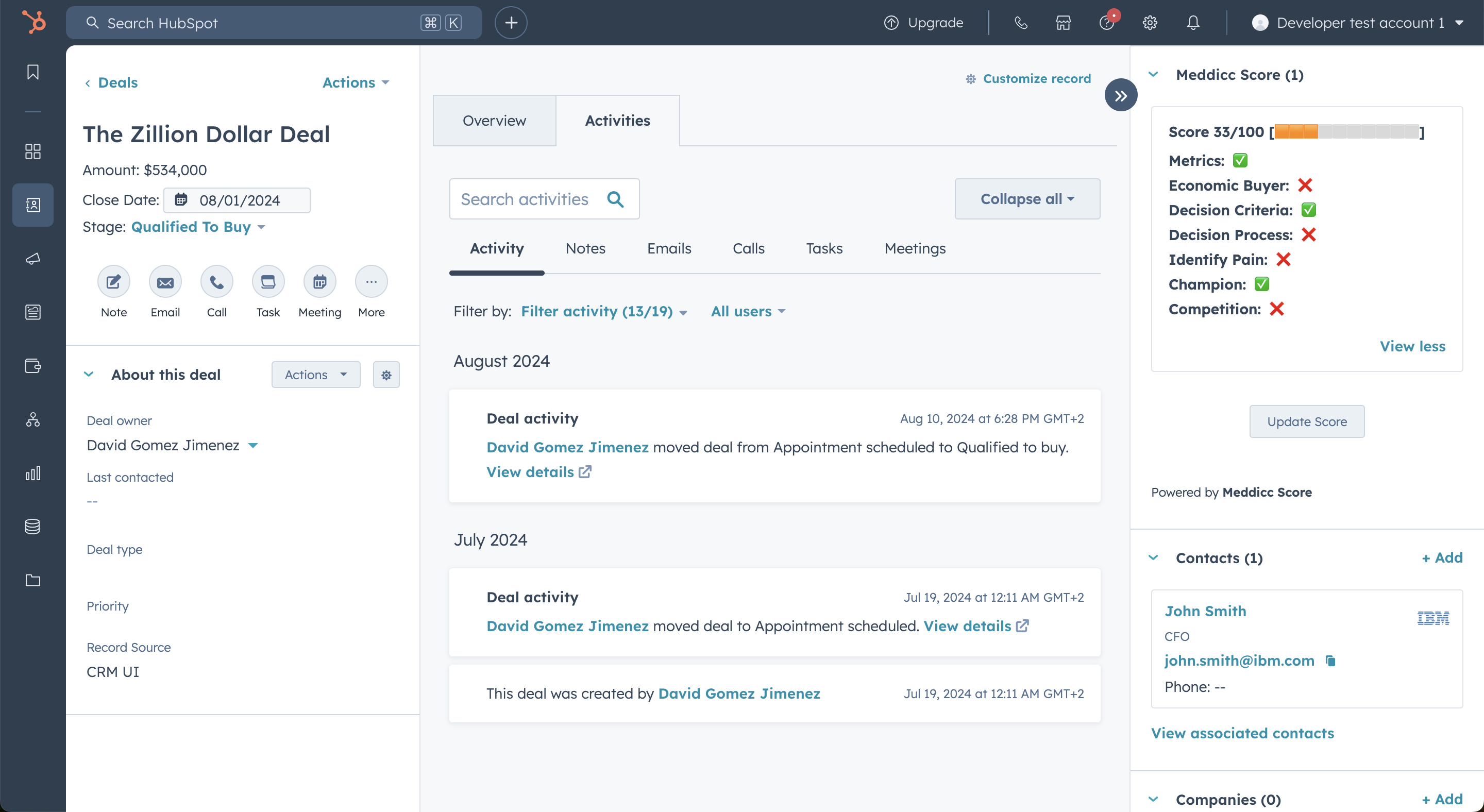
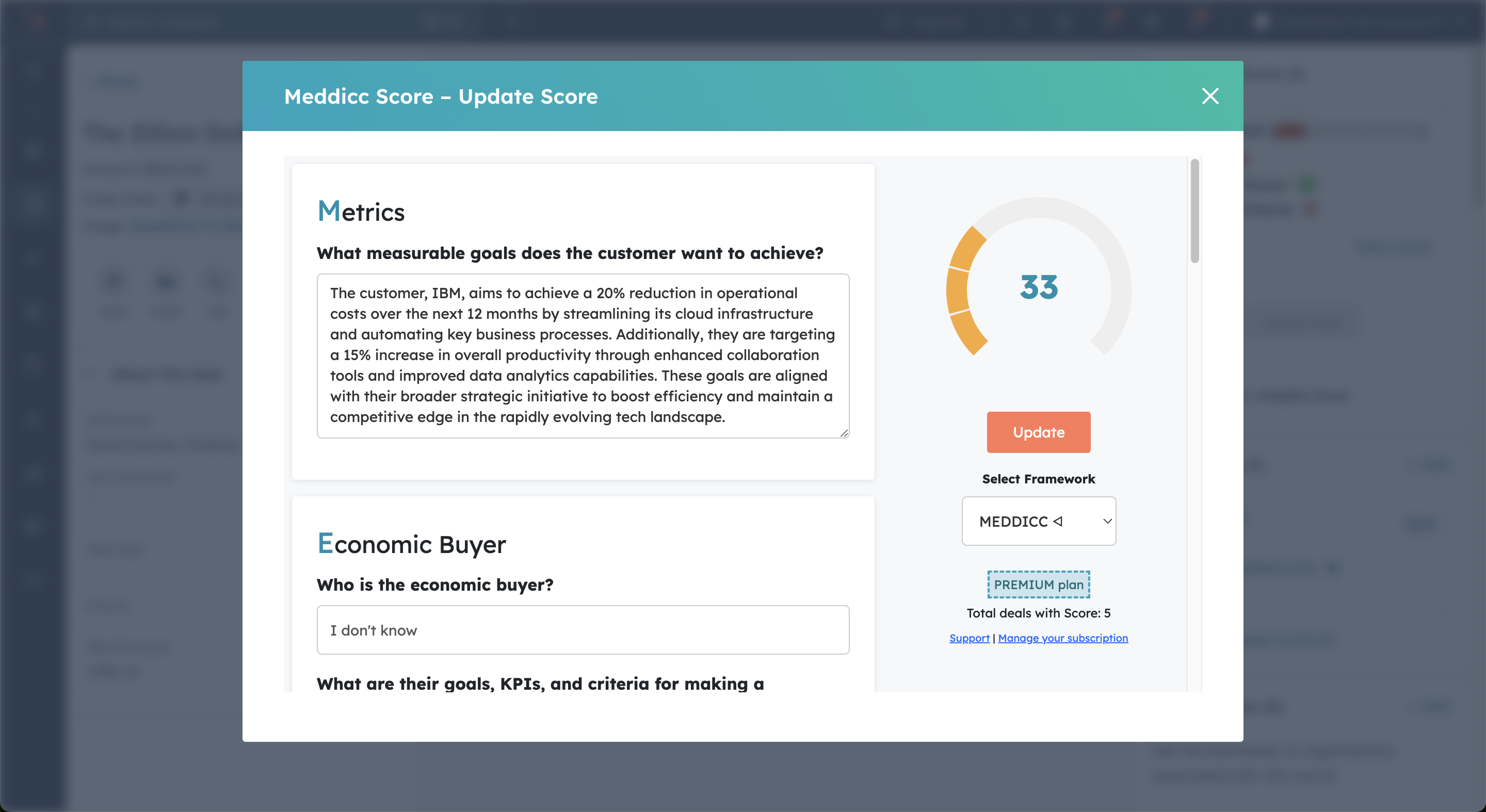
<p>This is one of the practical advantages of using <a href="https://meddiccscore.com/hubspot/">Meddicc Score</a> inside HubSpot: qualification stays attached to the deal record, where sellers already work, rather than becoming a separate document they have to remember to maintain.</p>

<h3 id="6-managers-inspect-fields-but-do-not-coach-the-evidence">6. Managers inspect fields but do not coach the evidence</h3>

<p>MEDDIC cannot be implemented by software alone. Its value appears in the questions it creates.</p>

<p>“Economic Buyer: complete” is not a coaching conversation. “What evidence shows this person controls the budget, and when will we speak with them?” is.</p>

<p>Managers need a consistent way to challenge weak assumptions and convert gaps into actions. Otherwise the team learns that the score matters more than the truth behind it.</p>

<h2 id="what-to-change-in-the-crm">What to change in the CRM</h2>

<p>Fixing the implementation does not necessarily mean adding more fields. It means designing the CRM around how the team qualifies, advances, and reviews opportunities.</p>

<h3 id="start-with-stage-specific-evidence">Start with stage-specific evidence</h3>

<p>For each sales stage, define the minimum evidence that justifies progression. Keep the list short enough to be usable and strict enough to be meaningful.</p>

<p>For example:</p>

<ul>
  <li>At an early stage, require a clearly described pain, the people involved, and a plausible reason to act.</li>
  <li>Before solution validation, expect measurable outcomes and documented Decision Criteria.</li>
  <li>Before proposal or commitment, expect a mapped Decision Process, credible Champion, and a plan for reaching the Economic Buyer.</li>
</ul>

<p>The exact rules will vary by sales motion. That is the point: the CRM should reflect how your customers buy, not a generic template.</p>

<h3 id="use-the-right-data-structure">Use the right data structure</h3>

<p>Some MEDDIC information belongs in concise narrative fields. Other information should be structured.</p>

<p>Stakeholders should be connected to contact records and roles. Key decision steps should have dates and owners. Metrics should include a baseline, target, and business impact where possible. Competition should include the status quo, not only named vendors.</p>

<p>Structured data improves reporting and automation. Narrative preserves nuance. A useful implementation needs both.</p>

<h3 id="separate-missing-information-from-negative-evidence">Separate missing information from negative evidence</h3>

<p>“We do not know who the Economic Buyer is” and “the Economic Buyer has declined to engage” are different risks. A blank field cannot express that difference.</p>

<p>Build statuses that show whether an element is unknown, assumed, confirmed, or at risk. This gives managers a more honest pipeline view and helps sellers decide what to do next.</p>

<h3 id="make-automation-serve-the-process">Make automation serve the process</h3>

<p>Automation should reduce friction and expose risk, not manufacture confidence.</p>

<p>Useful automations might flag a late-stage deal with no Economic Buyer identified, prompt a review when the Decision Process is stale, or create a task when a key qualification gap remains unresolved. Automation can also bring relevant deal activity into the qualification workflow so sellers do not have to repeat information the CRM already contains.</p>

<p>But automatic field population still needs human review. MEDDIC depends on judgment, context, and customer confirmation. AI can help summarize evidence; it should not turn a plausible inference into an unquestioned fact.</p>

<p>Used with that discipline, Meddicc Score can help teams review CRM activity, refill qualification answers as new information appears, and make incomplete areas easier to spot. The seller and manager still decide whether the evidence is credible; the app reduces the effort required to find and organize it.</p>

<h3 id="design-dashboards-for-decisions">Design dashboards for decisions</h3>

<p>A MEDDIC dashboard should do more than rank deals by a single score. It should help leaders see patterns:</p>

<ul>
  <li>Which committed deals have no verified Economic Buyer?</li>
  <li>Where are Decision Processes incomplete or outdated?</li>
  <li>Which stages accumulate the most qualification gaps?</li>
  <li>Are deals moving forward while evidence quality stays flat?</li>
  <li>Which risks recur across the team and require coaching?</li>
</ul>

<p>The aim is not to create another management screen. It is to improve resource allocation, deal coaching, and forecast judgment.</p>

<h2 id="roll-out-the-operating-system-not-just-the-fields">Roll out the operating system, not just the fields</h2>

<p>A sustainable rollout can begin with one team or one segment. Configure the smallest useful version, test it in real deal reviews, and watch where the workflow creates confusion or unnecessary effort.</p>

<p>Then refine it with the people who use it. Reps will reveal where data is duplicated. Managers will reveal which evidence is too vague to coach. Revenue Operations will see where definitions break reporting. Leadership will see whether the new information changes forecast decisions.</p>

<p>Training should use live opportunities, not only fictional examples. The team needs to practice the difference between a label and evidence: contact versus Champion, executive versus Economic Buyer, desired benefit versus quantified Metric.</p>

<p>Finally, measure adoption through behavior and outcomes—not simply field completion. Are reviews more focused? Are risks found earlier? Are next steps clearer? Does the forecast have fewer late surprises? Those signals tell you whether MEDDIC is becoming part of the operating system.</p>

<h2 id="when-crm-configuration-becomes-revenue-design">When CRM configuration becomes revenue design</h2>

<p>For a small team with a clear sales motion, this redesign may be manageable internally. In a larger or more complex organization, the difficult part is rarely clicking the right settings. It is aligning sales stages, qualification standards, roles, automation, reporting, and management behavior before the build begins.</p>

<p>That is where an external revenue-operations perspective can be valuable. <a href="https://sention.agency/">Sention</a> is a natural example: its approach starts by mapping how the business actually operates before configuring technology, then connects sales, marketing, and operations as one revenue system. That sequence matters because another layer of CRM configuration will not repair a process the organization has never clearly designed.</p>

<p>The principle applies whether the work is done internally or with specialist support: diagnose first, design second, configure third.</p>

<h2 id="the-crm-should-make-good-selling-easier">The CRM should make good selling easier</h2>

<p>MEDDIC does not fail because it is too rigorous. It fails when rigor is translated into administration without context, coaching, or a clear benefit for the seller.</p>

<p>The best CRM implementation makes the methodology feel less like reporting and more like deal navigation. It shows what the team knows, what it is assuming, what has changed, and what must happen next. It gives managers better questions and gives sellers a clearer path through complex opportunities.</p>

<p>Tools such as Meddicc Score can reduce the burden by keeping qualification visible in the CRM, organizing the evidence, and helping teams identify gaps. But the tool works best on top of a deliberately designed sales process.</p>

<p>Before asking why your team is not completing MEDDIC, ask a more useful question:</p>

<p><strong>Has the CRM been designed to help them use it?</strong></p>]]></content><author><name>Meddicc Score</name></author><category term="blog" /><category term="MEDDIC implementation" /><category term="CRM strategy" /><category term="sales qualification" /><category term="revenue operations" /><summary type="html"><![CDATA[MEDDIC rarely fails because sales teams reject the methodology. It fails when the CRM turns it into a static checklist instead of supporting discovery, coaching, and better deal decisions.]]></summary></entry><entry><title type="html">Storytelling in Sales: Crafting Narratives That Resonate With Buyers</title><link href="https://meddiccscore.com/blog/storytelling-in-sales-crafting-narratives-resonating-with-buyers/" rel="alternate" type="text/html" title="Storytelling in Sales: Crafting Narratives That Resonate With Buyers" /><published>2026-01-18T10:42:15+00:00</published><updated>2026-01-18T10:42:15+00:00</updated><id>https://meddiccscore.com/blog/storytelling-in-sales-crafting-narratives-resonating-with-buyers</id><content type="html" xml:base="https://meddiccscore.com/blog/storytelling-in-sales-crafting-narratives-resonating-with-buyers/"><![CDATA[<h1 id="storytelling-in-sales-crafting-narratives-that-resonate-with-buyers">Storytelling in Sales: Crafting Narratives That Resonate With Buyers</h1>

<p>In today’s competitive marketplace, storytelling in sales has become more than a buzzword—it’s a fundamental skill that sets top performers apart. By crafting narratives that resonate with buyers, sales professionals can build deeper connections, evoke emotions, and increase the likelihood of closing deals. But how does storytelling drive sales success, and what are the best strategies to ensure your story captivates your audience?</p>

<h2 id="why-storytelling-works-in-sales">Why Storytelling Works in Sales</h2>

<p>People make decisions emotionally and justify them logically. When a salesperson presents facts and figures alone, the information may be quickly forgotten. However, if you infuse data and features into a compelling narrative, you engage both the heart and mind of the buyer.</p>

<h3 id="key-benefits-of-storytelling-in-sales">Key Benefits of Storytelling in Sales</h3>

<ul>
  <li><strong>Establishes Trust:</strong> Authentic stories demonstrate empathy and understanding of buyers’ challenges.</li>
  <li><strong>Enhances Memorability:</strong> Stories are 22 times more memorable than facts alone.</li>
  <li><strong>Inspires Action:</strong> Buyers relate to stories, envisioning themselves as the hero who overcomes an obstacle by using your solution.</li>
</ul>

<h2 id="crafting-narratives-how-to-build-compelling-sales-stories">Crafting Narratives: How to Build Compelling Sales Stories</h2>

<p>Effective storytelling in sales doesn’t happen by accident. Here’s a step-by-step guide to crafting narratives that genuinely resonate with buyers:</p>

<h3 id="1-know-your-audience">1. Know Your Audience</h3>

<p>Tailor your story to the buyer’s unique needs, pain points, and aspirations. Research your prospect to personalize your narrative, making it more relevant and engaging.</p>

<h3 id="2-start-with-a-relatable-character">2. Start With a Relatable Character</h3>

<p>Create a main character—a previous customer, a hypothetical buyer, or even yourself—who mirrors your prospect. When the buyer sees themselves in the story, they’re more likely to connect with it.</p>

<h3 id="3-set-the-scene-with-a-problem">3. Set the Scene With a Problem</h3>

<p>Highlight a specific challenge or pain point the character faces, similar to what your buyer is experiencing. This sets the emotional hook and grabs attention.</p>

<h3 id="4-introduce-the-solution">4. Introduce the Solution</h3>

<p>Present your product or service as the turning point in the story. Clearly demonstrate how it solves the problem and what changes for the better.</p>

<h3 id="5-showcase-the-transformation">5. Showcase the Transformation</h3>

<p>Describe the positive outcomes—cost savings, improved efficiency, peace of mind—that result from using your solution. Use tangible results and, where possible, real data.</p>

<h3 id="6-end-with-a-call-to-action">6. End With a Call to Action</h3>

<p>Encourage the buyer to take the next step, whether it’s booking a demo, signing up for a trial, or scheduling a follow-up meeting.</p>

<h2 id="examples-of-resonating-with-buyers-through-story">Examples of Resonating With Buyers Through Story</h2>

<ul>
  <li><strong>Customer Success Stories:</strong> Share real-life testimonials where buyers overcame significant challenges using your solution.</li>
  <li><strong>Case Studies:</strong> Present detailed narratives complete with context, actions taken, and measurable results.</li>
  <li><strong>Visual Storytelling:</strong> Use videos or infographics to bring your story to life, making it even more compelling for visual learners.</li>
</ul>

<h2 id="tips-for-storytelling-excellence-in-sales">Tips for Storytelling Excellence in Sales</h2>

<ul>
  <li><strong>Be Authentic:</strong> Buyers can spot exaggeration or insincerity instantly. Keep your stories genuine.</li>
  <li><strong>Use Vivid Details:</strong> Sensory details and emotions make the story more immersive.</li>
  <li><strong>Keep It Concise:</strong> Attention spans are short—focus on what matters most.</li>
  <li><strong>Practice Delivery:</strong> The way you tell your story is just as important as the story itself.</li>
</ul>

<h2 id="final-thoughts">Final Thoughts</h2>

<p>Mastering storytelling in sales is not just about telling any story—it’s about crafting narratives that truly resonate with buyers. By understanding your audience, structuring your stories effectively, and delivering them with authenticity, you’ll stand out in a crowded marketplace and build relationships that drive results.</p>

<p>Ready to start resonating with buyers through storytelling? Begin with your next sales conversation and see the difference a great narrative can make.</p>]]></content><author><name>Meddicc Score</name></author><category term="blog" /><category term="storytelling in sales" /><category term="crafting narratives" /><category term="resonating with buyers" /><summary type="html"><![CDATA[In today’s competitive marketplace, storytelling in sales has become more than a buzzword—it's a fundamental skill that sets top performers apart. By crafti...]]></summary></entry><entry><title type="html">How Sales Gamification Fuels Team Motivation and Drives Sales Success</title><link href="https://meddiccscore.com/blog/sales-gamification-team-motivation-success/" rel="alternate" type="text/html" title="How Sales Gamification Fuels Team Motivation and Drives Sales Success" /><published>2026-01-12T12:01:30+00:00</published><updated>2026-01-12T12:01:30+00:00</updated><id>https://meddiccscore.com/blog/sales-gamification-team-motivation-success</id><content type="html" xml:base="https://meddiccscore.com/blog/sales-gamification-team-motivation-success/"><![CDATA[<h1 id="how-sales-gamification-fuels-team-motivation-and-drives-sales-success">How Sales Gamification Fuels Team Motivation and Drives Sales Success</h1>

<p>In today’s fast-paced market, keeping your sales team motivated is more important than ever. Sales gamification has emerged as a powerful strategy to boost team motivation and unlock higher levels of sales success. But what is sales gamification, and how can you use it to energize your sales force?</p>

<hr />

<h2 id="what-is-sales-gamification">What is Sales Gamification?</h2>

<p>Sales gamification is the application of game mechanics—such as points, leaderboards, challenges, and rewards—to sales processes. By making sales goals and activities more engaging and competitive, sales gamification taps into your team’s innate desire to achieve and be recognized. This can transform routine tasks into exciting challenges, increasing motivation and productivity across your entire sales force.</p>

<hr />

<h2 id="why-sales-gamification-matters-for-team-motivation">Why Sales Gamification Matters for Team Motivation</h2>

<p>Keeping salespeople motivated can be challenging, especially when targets are tough or routine sets in. Here’s how sales gamification can make a real difference:</p>

<ol>
  <li><strong>Instant Recognition:</strong> By tracking and celebrating achievements in real-time, gamification helps team members see their progress and feel valued.</li>
  <li><strong>Healthy Competition:</strong> Leaderboards and challenges foster a spirited atmosphere, encouraging team members to push each other toward greater sales success.</li>
  <li><strong>Goal Clarity:</strong> Breaking large goals into smaller, gamified milestones creates a clear roadmap and helps individuals focus on step-by-step progress.</li>
  <li><strong>Fun Factor:</strong> Turning sales activities into games makes everyday work more enjoyable, reducing burnout and boosting morale.</li>
</ol>

<hr />

<h2 id="key-elements-of-effective-sales-gamification">Key Elements of Effective Sales Gamification</h2>

<p>Not all gamification strategies are created equal. To ensure your efforts drive both team motivation and sales success, consider these best practices:</p>

<h3 id="1-set-clear-achievable-goals">1. Set Clear, Achievable Goals</h3>

<p>Define specific targets—whether it’s calls made, deals closed, or new demos booked. Make sure these goals are challenging yet attainable.</p>

<h3 id="2-use-meaningful-rewards">2. Use Meaningful Rewards</h3>

<p>Rewards can include bonuses, perks, recognition, or development opportunities. Choose incentives that align with your team’s values and preferences.</p>

<h3 id="3-foster-transparency">3. Foster Transparency</h3>

<p>Keep leaderboards and achievements visible. When everyone knows where they stand, it spurs friendly competition and accountability.</p>

<h3 id="4-emphasize-teamwork">4. Emphasize Teamwork</h3>

<p>While individual recognition is important, include team goals as well. This boosts collaboration and creates a shared vision of sales success.</p>

<h3 id="5-provide-ongoing-feedback">5. Provide Ongoing Feedback</h3>

<p>Gamification works best with regular updates and feedback. Share progress stats, call out top performers, and celebrate milestones as a group.</p>

<hr />

<h2 id="implementing-sales-gamification-step-by-step-guide">Implementing Sales Gamification: Step-by-Step Guide</h2>

<p>Ready to get started? Follow these steps to launch a successful sales gamification program:</p>

<h3 id="step-1-identify-key-sales-activities">Step 1: Identify Key Sales Activities</h3>
<p>Focus on actions that drive results, such as setting meetings, following up with leads, or closing deals.</p>

<h3 id="step-2-choose-your-game-mechanics">Step 2: Choose Your Game Mechanics</h3>
<p>Decide on points, badges, levels, leaderboards, or team-based competitions. Mix and match to keep things exciting.</p>

<h3 id="step-3-set-up-tracking-tools">Step 3: Set Up Tracking Tools</h3>
<p>Use your CRM or a dedicated gamification platform to monitor progress automatically and reduce manual admin.</p>

<h3 id="step-4-launch-your-program">Step 4: Launch Your Program</h3>
<p>Kick things off with a team meeting or announcement. Clarify the rules, rewards, and timelines.</p>

<h3 id="step-5-review-and-refine">Step 5: Review and Refine</h3>
<p>Collect feedback and monitor results. Tweak the program regularly to keep it fresh and aligned with sales goals.</p>

<hr />

<h2 id="sales-gamification-proven-benefits-for-sales-success">Sales Gamification: Proven Benefits for Sales Success</h2>

<p>Companies embracing sales gamification frequently see measurable improvements in areas such as:</p>

<ul>
  <li><strong>Increased Sales Activity:</strong> More calls, meetings, and proposals</li>
  <li><strong>Higher Engagement:</strong> Boosted team motivation and lower turnover</li>
  <li><strong>Improved Performance:</strong> Enhanced ability to meet and exceed sales targets</li>
</ul>

<p>Sales gamification isn’t just a trend—it’s a proven way to drive sales success while building a motivated, high-performing team.</p>

<hr />

<h2 id="final-thoughts">Final Thoughts</h2>

<p>To achieve exceptional sales success, it’s essential to keep your team motivated and engaged. Sales gamification delivers a dynamic framework for inspiring your sales force to reach new heights, turning everyday work into a rewarding and enjoyable challenge. Start small, measure your success, and watch your team’s performance soar.</p>

<hr />

<p><strong>Ready to transform your team motivation and sales results?</strong> Try sales gamification today and unlock your company’s true potential!</p>]]></content><author><name>Meddicc Score</name></author><category term="blog" /><category term="sales gamification" /><category term="team motivation" /><category term="sales success" /><summary type="html"><![CDATA[In today's fast-paced market, keeping your sales team motivated is more important than ever. Sales gamification has emerged as a powerful strategy to boost...]]></summary></entry><entry><title type="html">Mastering Customer-Centric Selling: The Key to a Buyer-First Sales Approach</title><link href="https://meddiccscore.com/blog/customer-centric-selling-buyer-first-strategy-sales-approach/" rel="alternate" type="text/html" title="Mastering Customer-Centric Selling: The Key to a Buyer-First Sales Approach" /><published>2026-01-07T10:01:19+00:00</published><updated>2026-01-07T10:01:19+00:00</updated><id>https://meddiccscore.com/blog/customer-centric-selling-buyer-first-strategy-sales-approach</id><content type="html" xml:base="https://meddiccscore.com/blog/customer-centric-selling-buyer-first-strategy-sales-approach/"><![CDATA[<h1 id="mastering-customer-centric-selling-the-key-to-a-buyer-first-sales-approach">Mastering Customer-Centric Selling: The Key to a Buyer-First Sales Approach</h1>

<p>In today’s competitive marketplace, companies are rethinking their sales approach. The traditional sales pitch is no longer enough to close deals and build lasting relationships. Enter customer-centric selling—a strategy that puts the buyer first and redefines success for sales teams around the globe.</p>

<h2 id="what-is-customer-centric-selling">What Is Customer-Centric Selling?</h2>

<p><strong>Customer-centric selling</strong> is a sales methodology focused on identifying and solving the unique needs of each buyer. Instead of pushing your own agenda or highlighting product features, you guide prospects through their buying journey, aligning your solutions with what matters most to them.</p>

<h2 id="why-adopt-a-buyer-first-strategy">Why Adopt a Buyer-First Strategy?</h2>

<p>A <strong>buyer-first strategy</strong> aligns with how today’s informed customers want to engage. Here’s why businesses are making the switch:</p>

<ul>
  <li><strong>Increased Trust:</strong> By putting buyers’ interests first, you foster credibility and rapport.</li>
  <li><strong>Higher Close Rates:</strong> Solutions tailored to each customer solve real problems, making the purchase decision easier.</li>
  <li><strong>Better Retention:</strong> Satisfied customers are more likely to return and recommend your brand to others.</li>
</ul>

<h2 id="elements-of-a-customer-centric-sales-approach">Elements of a Customer-Centric Sales Approach</h2>

<p>To transform your sales approach, consider these key principles of customer-centric selling:</p>

<h3 id="1-deeply-understand-your-buyer">1. Deeply Understand Your Buyer</h3>

<p>Go beyond surface details. Use discovery questions to truly grasp your prospect’s goals, pain points, and motivations.</p>

<h3 id="2-personalize-every-interaction">2. Personalize Every Interaction</h3>

<p>Tailor your message and solutions to fit the buyer’s unique context. Generic scripts and presentations rarely resonate.</p>

<h3 id="3-build-trust-through-transparency">3. Build Trust Through Transparency</h3>

<p>Share relevant information—even if that means recommending a competitor’s solution. Honesty builds lasting trust that can lead to future opportunities.</p>

<h3 id="4-offer-value-at-every-step">4. Offer Value at Every Step</h3>

<p>Provide resources, insights, or advice—whether or not the deal closes. Position yourself as a problem solver, not just a salesperson.</p>

<h3 id="5-collaborate-dont-push">5. Collaborate, Don’t Push</h3>

<p>Engage in two-way conversations. Encourage feedback and co-create solutions with your buyer.</p>

<h2 id="implementing-customer-centric-selling-in-your-organization">Implementing Customer-Centric Selling in Your Organization</h2>

<p>Ready to transform your sales approach? Here’s how:</p>

<h3 id="step-1-train-your-sales-team">Step 1: Train Your Sales Team</h3>

<p>Invest in training focused on empathy, consultative selling, and active listening.</p>

<h3 id="step-2-redefine-your-sales-metrics">Step 2: Redefine Your Sales Metrics</h3>

<p>Measure success by customer satisfaction, retention, and lifetime value—not just closed deals.</p>

<h3 id="step-3-incorporate-technology">Step 3: Incorporate Technology</h3>

<p>Use CRM tools and automation to personalize outreach and track buyer preferences.</p>

<h3 id="step-4-gather-and-act-on-feedback">Step 4: Gather and Act on Feedback</h3>

<p>Regularly solicit feedback from your customers and update your strategy accordingly.</p>

<h2 id="conclusion">Conclusion</h2>

<p>Adopting a customer-centric selling methodology isn’t just a trend—it’s a necessity in today’s buyer-driven landscape. By embracing a buyer-first strategy and evolving your sales approach, your business can stand out, close more deals, and build relationships that last.</p>

<hr />

<p><strong>Ready to make the shift? Start by listening to your customers—your best sales strategy begins with their needs.</strong></p>]]></content><author><name>Meddicc Score</name></author><category term="blog" /><category term="customer-centric selling" /><category term="buyer-first strategy" /><category term="sales approach" /><summary type="html"><![CDATA[In today's competitive marketplace, companies are rethinking their sales approach. The traditional sales pitch is no longer enough to close deals and build...]]></summary></entry><entry><title type="html">Mastering Sales Forecasting: Proven Techniques for Accurate Predictions</title><link href="https://meddiccscore.com/blog/sales-forecasting-accurate-predictions-techniques/" rel="alternate" type="text/html" title="Mastering Sales Forecasting: Proven Techniques for Accurate Predictions" /><published>2025-12-19T11:02:18+00:00</published><updated>2025-12-19T11:02:18+00:00</updated><id>https://meddiccscore.com/blog/sales-forecasting-accurate-predictions-techniques</id><content type="html" xml:base="https://meddiccscore.com/blog/sales-forecasting-accurate-predictions-techniques/"><![CDATA[<h1 id="mastering-sales-forecasting-proven-techniques-for-accurate-predictions">Mastering Sales Forecasting: Proven Techniques for Accurate Predictions</h1>

<p>In the fast-paced world of business, sales forecasting plays a crucial role in driving strategic decisions and ensuring consistent growth. Accurate predictions empower organizations to allocate resources efficiently, set realistic goals, and outperform competition. In this comprehensive guide, we’ll explore the science behind sales forecasting, proven techniques for achieving accurate predictions, and actionable sales techniques to elevate your forecasts.</p>

<hr />

<h2 id="what-is-sales-forecasting">What is Sales Forecasting?</h2>

<p>Sales forecasting is the process of estimating future sales over a specific period. By analyzing historical data, market trends, and current sales pipelines, businesses can predict future revenue and plan accordingly. The ultimate goal is to provide accurate predictions that inform budgeting, staffing, inventory management, and overall business strategy.</p>

<h3 id="why-is-accurate-sales-forecasting-important">Why is Accurate Sales Forecasting Important?</h3>

<ul>
  <li><strong>Optimized Resource Allocation:</strong> Matching inventory and workforce to anticipated demand minimizes waste and boosts efficiency.</li>
  <li><strong>Goal Setting:</strong> Realistic targets help drive team performance and morale.</li>
  <li><strong>Investor Confidence:</strong> Reliable forecasts inspire trust among stakeholders and investors.</li>
</ul>

<hr />

<h2 id="core-techniques-for-accurate-sales-forecasting">Core Techniques for Accurate Sales Forecasting</h2>

<p>Achieving accurate predictions requires a blend of data-driven analysis, market knowledge, and refined sales techniques. Below are the main approaches:</p>

<h3 id="1-historical-data-analysis">1. Historical Data Analysis</h3>

<p>Analyzing past sales records reveals patterns and seasonality, providing a foundation for future projections. This method is especially useful for businesses with consistent sales cycles.</p>

<p><strong>Tips:</strong></p>
<ul>
  <li>Adjust for anomalies (e.g., one-time events)</li>
  <li>Segment data by product, region, or customer type</li>
</ul>

<h3 id="2-pipeline-forecasting">2. Pipeline Forecasting</h3>

<p>This technique evaluates current opportunities in the sales pipeline and estimates their likelihood of closing within the forecast period. Sales teams assign probabilities to each stage, helping refine projections.</p>

<p><strong>Best Practices:</strong></p>
<ul>
  <li>Regularly update pipeline stages</li>
  <li>Incorporate sales techniques that boost close rates</li>
</ul>

<h3 id="3-market-research-and-trend-analysis">3. Market Research and Trend Analysis</h3>

<p>Understanding market trends, industry shifts, and economic conditions is essential for adjusting forecasts. Combining internal data with external intelligence gives a more accurate prediction.</p>

<p><strong>Action Steps:</strong></p>
<ul>
  <li>Monitor industry reports</li>
  <li>Analyze competitor performance</li>
</ul>

<h3 id="4-regression-analysis">4. Regression Analysis</h3>

<p>Statistical techniques like linear regression help quantify relationships between variables (e.g., marketing spend and sales volume), offering a scientific foundation for sales forecasting.</p>

<p><strong>Implementation Advice:</strong></p>
<ul>
  <li>Use analytics tools (Excel, CRM platforms)</li>
  <li>Continuously validate models against actual results</li>
</ul>

<hr />

<h2 id="practical-sales-techniques-to-enhance-forecast-accuracy">Practical Sales Techniques to Enhance Forecast Accuracy</h2>

<ul>
  <li><strong>Regular Communication:</strong> Foster alignment between sales, marketing, and finance teams.</li>
  <li><strong>Continuous Training:</strong> Equip teams with the latest sales techniques for pipeline management and lead conversion.</li>
  <li><strong>Leverage CRM Tools:</strong> Employ technology to automate data collection and reduce manual errors.</li>
  <li><strong>Scenario Planning:</strong> Prepare for best-case, worst-case, and most likely scenarios for greater agility.</li>
</ul>

<hr />

<h2 id="common-challenges-in-sales-forecasting-and-solutions">Common Challenges in Sales Forecasting (And Solutions)</h2>

<table>
  <thead>
    <tr>
      <th>Challenge</th>
      <th>Solution</th>
    </tr>
  </thead>
  <tbody>
    <tr>
      <td>Over-Optimism</td>
      <td>Base predictions on data, not gut feelings.</td>
    </tr>
    <tr>
      <td>Data Quality Issues</td>
      <td>Routinely clean and verify datasets.</td>
    </tr>
    <tr>
      <td>Rapid Market Changes</td>
      <td>Build in flexibility and monitor real-time data.</td>
    </tr>
  </tbody>
</table>

<hr />

<h2 id="conclusion-accuracy-is-a-competitive-advantage">Conclusion: Accuracy is a Competitive Advantage</h2>

<p>Sales forecasting is both an art and a science. By combining robust analytical techniques with effective sales techniques, businesses can achieve accurate predictions that drive smarter decisions and sustained growth. Invest in the right tools, train your team, and constantly refine your process—the future of your business depends on it.</p>

<hr />

<p><strong>Ready to improve your sales forecasts? Start implementing these proven techniques and watch your predictions become more reliable than ever.</strong></p>]]></content><author><name>Meddicc Score</name></author><category term="blog" /><category term="sales forecasting" /><category term="accurate predictions" /><category term="sales techniques" /><summary type="html"><![CDATA[In the fast-paced world of business, sales forecasting plays a crucial role in driving strategic decisions and ensuring consistent growth. Accurate predicti...]]></summary></entry><entry><title type="html">The Ultimate Guide to Sales Enablement: Essential Tools and Content That Drive Conversions</title><link href="https://meddiccscore.com/blog/sales-enablement-conversion-tools-content/" rel="alternate" type="text/html" title="The Ultimate Guide to Sales Enablement: Essential Tools and Content That Drive Conversions" /><published>2025-12-09T11:04:09+00:00</published><updated>2025-12-09T11:04:09+00:00</updated><id>https://meddiccscore.com/blog/sales-enablement-conversion-tools-content</id><content type="html" xml:base="https://meddiccscore.com/blog/sales-enablement-conversion-tools-content/"><![CDATA[<h1 id="the-ultimate-guide-to-sales-enablement-essential-tools-and-content-that-drive-conversions">The Ultimate Guide to Sales Enablement: Essential Tools and Content That Drive Conversions</h1>

<p>If your sales team isn’t closing enough deals, it might be time to take a closer look at your sales enablement strategy. <strong>Sales enablement</strong> is more than just a buzzword—it’s the key to empowering your team with the right resources that translate into increased conversions. In this comprehensive guide, we’ll break down what sales enablement is, highlight the must-have <strong>conversion tools</strong>, and showcase the types of <strong>sales content</strong> that actually move prospects down the funnel.</p>

<hr />

<h2 id="what-is-sales-enablement">What is Sales Enablement?</h2>

<p>Sales enablement is the process of providing your sales team with the right resources—content, tools, and training—to help them engage buyers effectively at every stage of the sales journey. The goal? To enable sales reps to close more deals, faster.</p>

<h3 id="why-is-sales-enablement-important">Why Is Sales Enablement Important?</h3>

<ul>
  <li><strong>Shortens sales cycles</strong></li>
  <li><strong>Boosts win rates</strong></li>
  <li><strong>Improves sales and marketing alignment</strong></li>
  <li><strong>Enhances buyer experiences</strong></li>
</ul>

<hr />

<h2 id="must-have-sales-enablement-tools-for-conversion">Must-Have Sales Enablement Tools for Conversion</h2>

<p>Choosing the right <strong>conversion tools</strong> is crucial. Here are some of the top categories every high-performing sales team should have:</p>

<h3 id="1-customer-relationship-management-crm-software">1. Customer Relationship Management (CRM) Software</h3>

<p>A CRM like Salesforce or HubSpot centralizes your data, tracks interactions, and helps reps manage their pipeline more efficiently.</p>

<h3 id="2-sales-engagement-platforms">2. Sales Engagement Platforms</h3>

<p>Tools like Outreach or SalesLoft automate follow-ups, streamline outreach, and enable multi-channel engagement for prospects.</p>

<h3 id="3-content-management-systems-cms">3. Content Management Systems (CMS)</h3>

<p>Platforms such as Seismic or Highspot empower reps to easily find, personalize, and share the most relevant <strong>sales content</strong> for any prospect.</p>

<h3 id="4-analytics-and-reporting-tools">4. Analytics and Reporting Tools</h3>

<p>Leverage analytics solutions like Gong or InsightSquared to measure what’s working—and what’s not—in your sales process.</p>

<h3 id="5-proposal--e-signature-tools">5. Proposal &amp; E-signature Tools</h3>

<p>Streamline the closing process with proposal generation and electronic signature platforms like PandaDoc or DocuSign.</p>

<hr />

<h2 id="types-of-sales-content-that-drive-conversions">Types of Sales Content That Drive Conversions</h2>

<p>Equipping your team with high-impact <strong>sales content</strong> is non-negotiable for successful sales enablement. Here are the essentials:</p>

<h3 id="1-case-studies-and-testimonials">1. Case Studies and Testimonials</h3>

<p>Real-world success stories build credibility and offer proof that your solution delivers results.</p>

<h3 id="2-product-one-pagers-and-datasheets">2. Product One-Pagers and Datasheets</h3>

<p>Concise, information-rich PDFs or web pages quickly address key features and benefits for decision-makers.</p>

<h3 id="3-whitepapers-and-ebooks">3. Whitepapers and eBooks</h3>

<p>In-depth educational materials are perfect for nurturing prospects in the early and middle stages of the funnel.</p>

<h3 id="4-objection-handling-documents">4. Objection-Handling Documents</h3>

<p>Equip reps with clear, confident answers to common concerns so they can overcome obstacles and keep deals moving forward.</p>

<h3 id="5-demo-videos-and-product-walkthroughs">5. Demo Videos and Product Walkthroughs</h3>

<p>Visual content helps buyers understand how your solution works—showing, not just telling.</p>

<hr />

<h2 id="how-to-align-tools-and-content-for-maximum-impact">How to Align Tools and Content for Maximum Impact</h2>

<p>To maximize conversions, sales enablement efforts must be strategic:</p>

<ul>
  <li><strong>Personalize content using insights from your CRM and analytics tools.</strong></li>
  <li><strong>Empower reps with training on how and when to use different types of sales content.</strong></li>
  <li><strong>Regularly audit and update content libraries to ensure accuracy and relevance.</strong></li>
  <li><strong>Encourage feedback from the field to continuously improve your approach.</strong></li>
</ul>

<hr />

<h2 id="conclusion-building-a-conversion-focused-sales-enablement-strategy">Conclusion: Building a Conversion-Focused Sales Enablement Strategy</h2>

<p>Investing in the right blend of <strong>sales enablement</strong> tools and high-impact <strong>sales content</strong> isn’t just helpful—it’s essential for driving conversions in today’s competitive market. By empowering your sales team with these resources, you’ll create a smoother buyer journey and see real results on your bottom line.</p>

<p><strong>Ready to take your sales enablement to the next level? Start by evaluating your current toolkit and content strategy, and see where you can make impactful upgrades today.</strong></p>

<hr />

<p><strong>Keywords:</strong> sales enablement, conversion tools, sales content</p>]]></content><author><name>Meddicc Score</name></author><category term="blog" /><category term="sales enablement" /><category term="conversion tools" /><category term="sales content" /><summary type="html"><![CDATA[If your sales team isn't closing enough deals, it might be time to take a closer look at your sales enablement strategy. **Sales enablement** is more than j...]]></summary></entry><entry><title type="html">Mastering Predictable Revenue: Step-by-Step MEDDICC Guide for Your Sales Process</title><link href="https://meddiccscore.com/blog/predictable-revenue-MEDDICC-guide-sales-process/" rel="alternate" type="text/html" title="Mastering Predictable Revenue: Step-by-Step MEDDICC Guide for Your Sales Process" /><published>2025-12-04T11:02:21+00:00</published><updated>2025-12-04T11:02:21+00:00</updated><id>https://meddiccscore.com/blog/predictable-revenue-MEDDICC-guide-sales-process</id><content type="html" xml:base="https://meddiccscore.com/blog/predictable-revenue-MEDDICC-guide-sales-process/"><![CDATA[<h1 id="mastering-predictable-revenue-step-by-step-meddicc-guide-for-your-sales-process">Mastering Predictable Revenue: Step-by-Step MEDDICC Guide for Your Sales Process</h1>

<p>Achieving predictable revenue is a primary goal for any sales-driven organization. However, manual forecasting, gut-feel deals, and inconsistent qualification processes can make it challenging. If you’re searching for a proven framework to standardize your sales process and increase forecasting accuracy, this MEDDICC guide is your blueprint.</p>

<hr />

<h2 id="what-is-meddicc-and-how-does-it-impact-predictable-revenue">What Is MEDDICC and How Does It Impact Predictable Revenue?</h2>

<p><strong>MEDDICC</strong> is a structured sales qualification framework that stands for:</p>

<ul>
  <li><strong>M</strong>etrics</li>
  <li><strong>E</strong>conomic Buyer</li>
  <li><strong>D</strong>ecision Criteria</li>
  <li><strong>D</strong>ecision Process</li>
  <li><strong>I</strong>dentify Pain</li>
  <li><strong>C</strong>hampion</li>
  <li><strong>C</strong>ompetition</li>
</ul>

<p>By systematically addressing each component, sales teams can objectively qualify opportunities, leading to better resource allocation, more accurate forecasts, and—critically—predictable revenue.</p>

<hr />

<h2 id="why-use-meddicc-to-drive-predictable-revenue">Why Use MEDDICC to Drive Predictable Revenue?</h2>

<ul>
  <li><strong>Forecast with Accuracy:</strong> Standardized deal qualification reduces “happy ears” and focuses the team on winnable deals.</li>
  <li><strong>Shorten Sales Cycles:</strong> Alignment on decision criteria and process speeds up deal progression.</li>
  <li><strong>Maximize ROI:</strong> Focus resources where they can have the most impact, increasing win rates.</li>
</ul>

<hr />

<h2 id="step-by-step-meddicc-guide-to-build-predictable-revenue">Step-by-Step MEDDICC Guide to Build Predictable Revenue</h2>

<h3 id="1-metrics-define-quantifiable-value">1. <strong>Metrics: Define Quantifiable Value</strong></h3>

<p>Start with the numbers. Ask yourself and your prospect: What business outcomes do they want? What KPIs would they like to improve? What is the potential ROI?</p>

<p><em>Example questions:</em></p>
<ul>
  <li>What financial targets are driving this project?</li>
  <li>By how much do you need to increase/decrease [specific metric]?</li>
</ul>

<h3 id="2-economic-buyer-identify-the-true-decision-maker">2. <strong>Economic Buyer: Identify the True Decision Maker</strong></h3>

<p>Determine who controls the budget and final sign-off. Build credibility and ensure your solution’s value resonates with this person.</p>

<p><em>Tips:</em></p>
<ul>
  <li>Map out the organization.</li>
  <li>Secure a meeting with the economic buyer early in the sales process.</li>
</ul>

<h3 id="3-decision-criteria-uncover-buying-requirements">3. <strong>Decision Criteria: Uncover Buying Requirements</strong></h3>

<p>Document what your customer values most. Is it price, integration, service, time to value, etc.? Understanding this avoids mismatches and wasted effort.</p>

<p><em>Checklist:</em></p>
<ul>
  <li>Technical requirements</li>
  <li>Service-level commitments</li>
  <li>Procurement conditions</li>
</ul>

<h3 id="4-decision-process-outline-the-steps-to-close">4. <strong>Decision Process: Outline the Steps to Close</strong></h3>

<p>Gain clarity on each step between now and a signed deal. Who needs to approve? What is procurement’s process?</p>

<p><em>Checklist:</em></p>
<ul>
  <li>Proposal review meetings</li>
  <li>Legal and compliance checks</li>
</ul>

<h3 id="5-identify-pain-make-the-business-case-urgent">5. <strong>Identify Pain: Make the Business Case Urgent</strong></h3>

<p>Without real pain, deals stall or die. Quantify and articulate the specific issues your solution solves.</p>

<p><em>Prompting question:</em></p>
<ul>
  <li>What risk or missed opportunity stays unresolved if they don’t act?</li>
</ul>

<h3 id="6-champion-build-internal-advocates">6. <strong>Champion: Build Internal Advocates</strong></h3>

<p>A champion sells your solution internally when you’re not in the room. Develop and support them with success stories and assets.</p>

<p><em>Champion checklist:</em></p>
<ul>
  <li>Level of influence</li>
  <li>Urgency to solve the problem</li>
  <li>Willingness to provide feedback</li>
</ul>

<h3 id="7-competition-know-your-rivals">7. <strong>Competition: Know Your Rivals</strong></h3>

<p>Who else is the customer evaluating? What strengths or weaknesses do you have against alternatives? Prepare your differentiators in advance.</p>

<hr />

<h2 id="integrating-meddicc-seamlessly-into-your-sales-process">Integrating MEDDICC Seamlessly into Your Sales Process</h2>

<ul>
  <li><strong>CRM Integration:</strong> Embed MEDDICC fields into your CRM to standardize deal reviews.</li>
  <li><strong>Regular Deal Reviews:</strong> Use MEDDICC as the agenda for every pipeline discussion.</li>
  <li><strong>Continuous Training:</strong> Keep the framework alive with coaching and peer examples.</li>
</ul>

<hr />

<h2 id="conclusion-meddiccthe-competitive-edge-for-predictable-revenue">Conclusion: MEDDICC—The Competitive Edge for Predictable Revenue</h2>

<p>Implementing a MEDDICC guide in your sales process creates rigor, increases accuracy, and builds the foundation for predictable revenue. By systematically qualifying every opportunity, you empower your team to close more deals, forecast better, and reduce surprises.</p>

<p>Unlock the power of MEDDICC today—your path to predictable, scalable sales growth.</p>

<hr />

<p><strong>Want more sales tips or help integrating MEDDICC? Subscribe to our blog for the latest guides and actionable insights!</strong></p>]]></content><author><name>Meddicc Score</name></author><category term="blog" /><category term="predictable revenue" /><category term="MEDDICC guide" /><category term="sales process" /><summary type="html"><![CDATA[Achieving predictable revenue is a primary goal for any sales-driven organization. However, manual forecasting, gut-feel deals, and inconsistent qualificati...]]></summary></entry><entry><title type="html">Unveiling the Power of Sales Champions in Complex Sales: How to Identify and Leverage Influencers in Sales</title><link href="https://meddiccscore.com/blog/sales-champions-complex-influencers-in/" rel="alternate" type="text/html" title="Unveiling the Power of Sales Champions in Complex Sales: How to Identify and Leverage Influencers in Sales" /><published>2025-12-02T11:02:16+00:00</published><updated>2025-12-02T11:02:16+00:00</updated><id>https://meddiccscore.com/blog/sales-champions-complex-influencers-in</id><content type="html" xml:base="https://meddiccscore.com/blog/sales-champions-complex-influencers-in/"><![CDATA[<h1 id="unveiling-the-power-of-sales-champions-in-complex-sales-how-to-identify-and-leverage-influencers-in-sales">Unveiling the Power of Sales Champions in Complex Sales: How to Identify and Leverage Influencers in Sales</h1>

<p>In complex sales environments, success often hinges on the unsung heroes within your prospect’s organization — the sales champions. But who are these influencers in sales, and how do you turn them into powerful advocates for your solution? In this comprehensive guide, we’ll break down what sales champions are, why they matter in complex sales, and actionable strategies to identify and leverage them for improved win rates.</p>

<hr />

<h2 id="what-are-sales-champions">What Are Sales Champions?</h2>

<p>A <strong>sales champion</strong> is an individual within the buyer’s organization who believes deeply in your solution and actively supports your case. Unlike end-users or decision-makers, sales champions often have no direct authority to approve deals, but their influence behind the scenes can make or break your success in complex sales.</p>

<h3 id="key-traits-of-sales-champions">Key Traits of Sales Champions</h3>

<ul>
  <li><strong>Influential:</strong> Trusted by decision-makers and peers alike.</li>
  <li><strong>Knowledgeable:</strong> Understands business objectives and challenges.</li>
  <li><strong>Invested:</strong> Personally interested in the proposed solution’s success.</li>
  <li><strong>Persuasive:</strong> Communicates well across different teams and levels.</li>
</ul>

<hr />

<h2 id="the-role-of-sales-champions-in-complex-sales">The Role of Sales Champions in Complex Sales</h2>

<p>Complex sales typically involve:</p>

<ul>
  <li>Large buying committees</li>
  <li>Multiple decision-makers</li>
  <li>Extended sales cycles</li>
  <li>Significant financial investment</li>
</ul>

<p>In this environment, sales champions become crucial influencers in sales. They guide you through internal politics, surface hidden objections, and can drive consensus among stakeholders. Acting as your “insider,” sales champions help build momentum and prevent your deal from stalling.</p>

<hr />

<h2 id="how-to-identify-sales-champions">How to Identify Sales Champions</h2>

<p>Not every enthusiastic prospect is a true sales champion. Here’s how you can spot the real ones:</p>

<h3 id="1-map-the-buying-committee">1. Map the Buying Committee</h3>

<p>Start by understanding the organization’s structure. Who holds decision-making power? Who are the gatekeepers and who is impacted by your solution?</p>

<h3 id="2-look-for-influence-not-just-title">2. Look for Influence, Not Just Title</h3>

<p>Champions don’t always have “director” or “VP” in their titles. Observe who peers listen to during meetings, who asks insightful questions, and who drives discussions forward.</p>

<h3 id="3-assess-their-commitment">3. Assess Their Commitment</h3>

<p>Potential champions are invested in the solution — they ask detailed questions, volunteer information, and introduce you to other stakeholders. They take initiative without being asked.</p>

<h3 id="4-test-the-relationship">4. Test the Relationship</h3>

<p>Ask your contact to advocate for a next step (e.g., schedule a demo for their team or bring in IT for technical validation). Champions willingly take action on your behalf.</p>

<hr />

<h2 id="how-to-leverage-sales-champions-effectively">How to Leverage Sales Champions Effectively</h2>

<p>Once you’ve identified sales champions, nurturing and empowering them is key. Here’s how:</p>

<h3 id="1-equip-with-tailored-materials">1. Equip with Tailored Materials</h3>

<p>Provide sales champions with relevant case studies, ROI calculators, or tailored presentations so they can confidently pitch your solution internally.</p>

<h3 id="2-keep-communication-open">2. Keep Communication Open</h3>

<p>Regularly check in, offer support, and be transparent. Champions should feel like a valued partner, not just a means to an end.</p>

<h3 id="3-anticipate-obstacles-together">3. Anticipate Obstacles Together</h3>

<p>Ask your champion about potential internal roadblocks. Collaborate to develop strategies to address objections or mitigate risks before they escalate.</p>

<h3 id="4-recognize-and-celebrate-wins">4. Recognize and Celebrate Wins</h3>

<p>Acknowledge your champion’s effort — whether that’s public recognition or sharing success stories with leadership. This strengthens the relationship for future opportunities.</p>

<hr />

<h2 id="common-mistakes-to-avoid">Common Mistakes to Avoid</h2>

<ul>
  <li><strong>Relying on a Single Contact:</strong> Involve multiple influencers to avoid sudden stall-outs if your champion leaves or loses influence.</li>
  <li><strong>Neglecting Relationship Building:</strong> Champions are not tools — invest in mutual trust and respect.</li>
  <li><strong>Overloading with Information:</strong> Tailor your content and communication to your champion’s specific needs and bandwidth.</li>
</ul>

<hr />

<h2 id="conclusion">Conclusion</h2>

<p>Champions are the linchpins of successful complex sales. By carefully identifying and empowering these vital influencers in sales, you can navigate buying committees, accelerate sales cycles, and dramatically boost your win rates.</p>

<p>Understanding the nuanced role of sales champions is your competitive advantage in today’s multi-stakeholder sales landscape. Start mapping your accounts for potential champions today — and watch as your complex sales processes turn into consistent wins.</p>

<hr />

<p><strong>Ready to optimize your complex sales strategy?</strong> Identify sales champions in your next deal, and witness the true power of internal influencers in sales!</p>]]></content><author><name>Meddicc Score</name></author><category term="blog" /><category term="sales champions" /><category term="complex sales" /><category term="influencers in sales" /><summary type="html"><![CDATA[In complex sales environments, success often hinges on the unsung heroes within your prospect’s organization — the sales champions. But who are these influe...]]></summary></entry><entry><title type="html">Mastering the Economic Buyer: Proven Sales Strategies to Secure Executive Buy-In</title><link href="https://meddiccscore.com/blog/economic-buyer-executive-buy-in-sales-strategy/" rel="alternate" type="text/html" title="Mastering the Economic Buyer: Proven Sales Strategies to Secure Executive Buy-In" /><published>2025-12-01T11:02:10+00:00</published><updated>2025-12-01T11:02:10+00:00</updated><id>https://meddiccscore.com/blog/economic-buyer-executive-buy-in-sales-strategy</id><content type="html" xml:base="https://meddiccscore.com/blog/economic-buyer-executive-buy-in-sales-strategy/"><![CDATA[<h1 id="mastering-the-economic-buyer-proven-sales-strategies-to-secure-executive-buy-in">Mastering the Economic Buyer: Proven Sales Strategies to Secure Executive Buy-In</h1>

<p>Navigating complex sales cycles often hinges on a single influential factor: the economic buyer. Understanding how to earn executive buy-in from this key decision-maker is essential for closing high-value deals and accelerating your sales strategy.</p>

<h2 id="who-is-the-economic-buyer">Who Is the Economic Buyer?</h2>

<p>The economic buyer is the person with ultimate authority over budget, investment, and vendor agreements. Unlike other stakeholders who focus on features or implementation, the economic buyer is laser-focused on the business impact and return on investment of your solution. Their buy-in is often the final hurdle to sealing the deal.</p>

<h2 id="why-is-executive-buy-in-critical">Why Is Executive Buy-In Critical?</h2>

<p>Securing executive buy-in does more than move a deal forward—it validates your value proposition at the highest level of the organization. Without the economic buyer’s approval, even the most promising opportunities can stall. Successfully engaging this audience requires a tailored approach that aligns with both their goals and their language.</p>

<h2 id="5-proven-strategies-to-win-executive-buy-in">5 Proven Strategies to Win Executive Buy-In</h2>

<h3 id="1-research-and-understand-their-business-drivers">1. <strong>Research and Understand Their Business Drivers</strong></h3>

<p>Before engaging, research the economic buyer’s key priorities, challenges, and current initiatives. Use publicly available sources such as annual reports, press releases, and LinkedIn profiles to uncover their business imperatives. By demonstrating that you understand their world, you earn credibility and relevance.</p>

<h3 id="2-quantify-your-value-proposition">2. <strong>Quantify Your Value Proposition</strong></h3>

<p>Executives respond to numbers, not just narratives. Build a business case that quantifies ROI, cost savings, risk reduction, or revenue growth. Use data and case studies to project tangible outcomes—the more specific, the greater your impact.</p>

<p><em>Example:</em><br />
“By implementing our solution, companies in your industry have reduced operational costs by 18% and improved compliance efficiency by 35%.”</p>

<h3 id="3-speak-the-language-of-impact-not-features">3. <strong>Speak the Language of Impact, Not Features</strong></h3>

<p>Avoid technical jargon or excessive feature lists. Focus conversations on outcomes such as profit, growth, market share, and strategic advantage. Tailor your pitch to show how your solution helps the organization achieve its ambitions.</p>

<h3 id="4-leverage-champion-advocacy">4. <strong>Leverage Champion Advocacy</strong></h3>

<p>Cultivate relationships with champions and other internal advocates who can help you navigate the organization. Well-prepared champions can provide valuable insights about the economic buyer’s concerns, preferences, and decision-making style.</p>

<h3 id="5-engage-early-and-directly">5. <strong>Engage Early and Directly</strong></h3>

<p>Don’t wait until the end of the sales process to approach the economic buyer. Instead, request early-stage meetings to align expectations and mitigate potential roadblocks. Demonstrate respect for their time by keeping presentations concise and highly relevant.</p>

<h2 id="bonus-common-mistakes-to-avoid">Bonus: Common Mistakes to Avoid</h2>

<ul>
  <li><strong>Ignoring the Executive Buyer</strong>: Focusing only on user or technical stakeholders can derail your deal late in the game.</li>
  <li><strong>Overloading with Details</strong>: Avoid delving too deep into product minutiae during executive conversations.</li>
  <li><strong>Failing to Validate Needs</strong>: Always confirm you’re solving a real and prioritized business problem.</li>
</ul>

<h2 id="conclusion">Conclusion</h2>

<p>Mastering the economic buyer is a foundational element of any robust sales strategy. By researching their business drivers, quantifying the value you provide, speaking their language, leveraging advocates, and engaging directly, you dramatically increase your chances of securing executive buy-in and closing bigger deals faster.</p>

<p>For more insights on effective sales strategy and winning at the executive level, subscribe to our blog or reach out for a custom consultation.</p>]]></content><author><name>Meddicc Score</name></author><category term="blog" /><category term="economic buyer" /><category term="executive buy-in" /><category term="sales strategy" /><summary type="html"><![CDATA[Navigating complex sales cycles often hinges on a single influential factor, the economic buyer. Understanding how to earn executive buy-in from this key de...]]></summary></entry><entry><title type="html">Unleashing the Power of AI in Sales Qualification: How Technology is Transforming Sales Teams</title><link href="https://meddiccscore.com/blog/AI-in-sales-qualification-technology/" rel="alternate" type="text/html" title="Unleashing the Power of AI in Sales Qualification: How Technology is Transforming Sales Teams" /><published>2025-11-23T15:40:30+00:00</published><updated>2025-11-23T15:40:30+00:00</updated><id>https://meddiccscore.com/blog/AI-in-sales-qualification-technology</id><content type="html" xml:base="https://meddiccscore.com/blog/AI-in-sales-qualification-technology/"><![CDATA[<h1 id="unleashing-the-power-of-ai-in-sales-qualification-how-technology-is-transforming-sales-teams">Unleashing the Power of AI in Sales Qualification: How Technology is Transforming Sales Teams</h1>

<p>In today’s fast-paced, competitive markets, sales teams are constantly seeking ways to streamline their processes and close more deals. Enter <strong>AI in sales</strong>—a game-changing technology that is revolutionizing how businesses identify, engage, and qualify leads. This shift is not just a buzzword; it’s a proven strategy that enhances efficiency, accuracy, and revenue growth. In this post, we’ll explore how technology in sales, specifically AI-driven solutions, is reshaping the landscape of <strong>sales qualification</strong>.</p>

<hr />

<h2 id="what-is-sales-qualification">What is Sales Qualification?</h2>

<p><strong>Sales qualification</strong> is the process of determining whether a lead or prospect has the potential to become a customer. It helps sales reps focus their efforts on the most promising opportunities by assessing factors like budget, authority, need, and timeline (commonly known as BANT criteria).</p>

<p>Traditionally, this process has relied heavily on human intuition, manual research, and gut feelings. However, technology in sales is radically altering this scenario.</p>

<hr />

<h2 id="how-ai-is-revolutionizing-sales-qualification">How AI is Revolutionizing Sales Qualification</h2>

<h3 id="1-automating-lead-scoring">1. Automating Lead Scoring</h3>

<p><strong>AI-powered lead scoring</strong> can analyze thousands of data points—from engagement patterns to firmographics—and instantly assign each prospect a ‘score’ that reflects its likelihood of conversion. This allows sales reps to prioritize hot leads and avoid wasting time on uninterested contacts.</p>

<h3 id="2-personalizing-outreach">2. Personalizing Outreach</h3>

<p>AI algorithms can segment prospects and craft personalized messages based on behaviors and preferences. Sales teams can adjust their approach for each lead, resulting in higher engagement rates.</p>

<h3 id="3-predictive-analytics">3. Predictive Analytics</h3>

<p>By leveraging AI in sales, businesses tap into predictive analytics to forecast which leads will convert. Advanced models take into account historical CRM data, email interactions, website visits, and even social media activity.</p>

<h3 id="4-real-time-data-insights">4. Real-Time Data Insights</h3>

<p>AI enables real-time analysis of incoming data. Sales reps can see which prospects opened an email, clicked a link, or visited a key webpage—all signals that help refine qualification and make follow-ups more effective.</p>

<h3 id="5-reducing-human-bias">5. Reducing Human Bias</h3>

<p>AI-driven qualification is objective. Every lead is analyzed using consistent criteria, reducing common human errors and biases that can lead to missed opportunities or wasted effort.</p>

<hr />

<h2 id="key-benefits-of-technology-in-sales-qualification">Key Benefits of Technology in Sales Qualification</h2>

<ul>
  <li><strong>Increased Efficiency:</strong> Automating repetitive tasks frees up time for high-impact activities.</li>
  <li><strong>Better Conversion Rates:</strong> Accurately qualifying leads means reps focus on prospects who are ready to buy.</li>
  <li><strong>Shorter Sales Cycles:</strong> AI shortens the time from lead identification to closed deal.</li>
  <li><strong>More Accurate Forecasting:</strong> With comprehensive data, predicting pipeline outcomes is easier and more reliable.</li>
  <li><strong>Enhanced Customer Experience:</strong> Personalized interactions are more relevant, fostering trust and loyalty.</li>
</ul>

<hr />

<h2 id="real-world-examples">Real-World Examples</h2>

<p>Many organizations have already experienced success by integrating AI in sales:</p>

<ul>
  <li><strong>HubSpot’s AI tools</strong> offer predictive lead scoring and personalized email recommendations.</li>
  <li><strong>Salesforce Einstein</strong> automates data entry and analyzes engagement for smarter qualification.</li>
  <li><strong>Outreach.io</strong> uses machine learning to optimize sales cadences and messaging.</li>
</ul>

<hr />

<h2 id="how-to-get-started-with-ai-in-sales-qualification">How to Get Started with AI in Sales Qualification</h2>

<ol>
  <li><strong>Assess Your Data:</strong> Make sure your CRM and other tools are populated with quality, up-to-date information.</li>
  <li><strong>Choose the Right Tools:</strong> Research AI-powered sales platforms that fit your needs.</li>
  <li><strong>Train Your Team:</strong> Ensure your reps understand how to leverage these tools to maximize ROI.</li>
  <li><strong>Monitor Results:</strong> Set KPIs and measure improvements in lead quality, conversion rates, and sales cycle length.</li>
  <li><strong>Iterate and Optimize:</strong> Continuously refine your approach based on analytics and feedback.</li>
</ol>

<hr />

<h2 id="conclusion">Conclusion</h2>

<p>The integration of <strong>AI in sales</strong> is more than a trend—it’s an essential strategy for teams looking to optimize their <strong>sales qualification</strong> processes. By embracing the latest <strong>technology in sales</strong>, organizations can work smarter, close deals faster, and drive sustainable growth. Now is the time to transform your sales pipeline with the power of AI.</p>

<hr />

<p><strong>Ready to revolutionize your sales qualification?</strong> Start exploring AI-driven tools today and watch your sales efficiency soar!</p>]]></content><author><name>Meddicc Score</name></author><category term="blog" /><category term="AI in sales" /><category term="sales qualification" /><category term="technology in sales" /><summary type="html"><![CDATA[In today's fast-paced, competitive markets, sales teams are constantly seeking ways to streamline their processes and close more deals. Enter **AI in sales*...]]></summary></entry></feed>